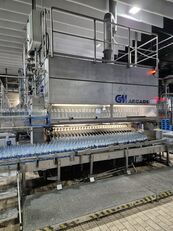
KHS Blomax 16 bottle cleaning machine


 Wentorf bei Hamburg

If you decide to buy equipment at a low price, make sure that you communicate with the real seller. Find out as much information about the owner of the equipment as possible. One way of cheating is to represent yourself as a real company. In case of suspicion, inform us about this for additional control, through the feedback form.
Before you decide to make a purchase, carefully review several sales offers to understand the average cost of your chosen equipment. If the price of the offer you like is much lower than similar offers, think about it. A significant price difference may indicate hidden defects or an attempt by the seller to commit fraudulent acts.
Do not buy products which price is too different from the average price for similar equipment.
Do not give consent to dubious pledges and prepaid goods. In case of doubt, do not be afraid to clarify details, ask for additional photographs and documents for equipment, check the authenticity of documents, ask questions.
The most common type of fraud. Unfair sellers may request a certain amount of advance payment to “book” your right to purchase equipment. Thus, fraudsters can collect a large amount and disappear, no longer get in touch.
- Transfer of prepayment to the card
- Do not make an advance payment without paperwork confirming the process of transferring money, if during the communication the seller is in doubt.
- Transfer to the “Trustee” account
- Such a request should be alarming, most likely you are communicating with a fraudster.
- Transfer to a company account with a similar name
- Be careful, fraudsters may disguise themselves as well-known companies, making minor changes to the name. Do not transfer funds if the company name is in doubt.
- Substitution of own details in the invoice of a real company
- Before making a transfer, make sure that the specified details are correct, and whether they relate to the specified company.
Seller's contacts


 Germany, Menslage


 Germany, Menslage

 Germany, Burgwald-Ernsthausen


 Germany, Menslage


 Germany, Burgwald-Ernsthausen


 Germany, Menslage
 Germany, Menslage


 Germany, Menslage


 Germany, Burgwald-Ernsthausen


 Germany, Menslage


 Germany, Menslage


 Germany, Burgwald-Ernsthausen


 Germany, Menslage


 Germany, Burgwald-Ernsthausen


 Germany, Burgwald-Ernsthausen


 Germany, Burgwald-Ernsthausen


 Germany, Menslage

 Germany, Menslage


 Germany, Menslage
Capacity: 28.800 bottles/h
Bottle size: min. 200 ml and max. 2.000 ml
Bottle neck nominal diameter: 38 mm
Production hours: 24.288 hours
Electrics: 380 V - 50 Hz - 3 pH - Earth
Space requirement: 11,60 x 10,60 x 3,10 meter
Nettogewicht: ± 27.500 kg
On behalf of our client
we are selling this KHS Blomax 16 PET blow molding machine which is designed for the automated production of PET bottles. It ran together with 2x KHS Absofill / ABF 710 machines before (one of these 2 also sold by our website
show contacts It is dismantled ± 8 years ago and is stored since in a closed warehouse. The client bought the machine used and decided not to blow bottles themselve
but buy them from another supplier
already blown. This bottle blower is direct available. Loading on the truck / inside the container will be done by the dairy factory.The machine was used to blow PET bottle for a fruit juice factory in Germany. Capacity: 28.800 bottles/h. Bottle size: min. 200 ml and max. 2.000 ml. Current bottle neck nominal diameter: 38 mm. With the same nominal bottle neck diameter
different bottles shapes and sizes can be blown. Max diameter of the bottle: 115 mm. Length of the bottle: min: 107 mm and max. 350 mm. Length of the prefrom: min. 60 mm and max. 185 mm. Power: 400 V - 3 Ph - 50 Hz - ± 300 kW. Total dimensions: ± 930 x 520 x 310 cm. Space requirement (length x width): 11,60 x 10,60 meter. Weight:± 27.500 kg.Working principle: The preforms are located in the feed hopper of the inclined conveyor. From here
they are transported to the roller sorter
which aligns the preforms. The preforms are transported via the feed rails to the loading station. Here
they are conveyed to the preform turner. The preform turner takes the preforms individually
turns them
and transfers them to the grippers of the loading station. The loading station places one preform at a time on a transport mandrel of the loading/unloading wheel. From here
the preforms – mounted on transport mandrels – pass through the machine. The preform or the produced bottle remains on the transport mandrel throughout the entire machine cycle. Transfer station I guides the transport mandrels with the preforms placed on them onto the mandrel holders of the linear furnace. Heating boxes with infrared heaters are housed in the linear furnace. At the end of the heating section
a pyrometer approximately 35 mm above the support ring non-contacts the temperature of the preforms. From the heating section
the preforms are transferred from transfer station II to the blow molding stations on the blow molding wheel. The movements of the blow molding station are
opening/closing the blow mold
raising/lowering the base mold
raising/lowering the stretching rod
raising/lowering the blow nozzle are controlled by cams. The "Lock mold" and "Unlock mold" curves are adjustable. The blow molding process consists of the stretching process and a two-stage blow molding process. The first pressure stage (P1) is used to blow the bottle
while the second
higher pressure stage (P2) is used to shape the bottle contour and press the bottle wall against the mold. By utilizing the AR blow air recirculation (AIRBACK®) – which serves to save blow air – the blow molding process proceeds. After the blow molding process is complete
the molds open
and Transfer Station III conveys the transport mandrels containing the finished bottles to the loading/unloading wheel. From here
the bottles enter the bottle turning wheel. Here
they are picked up by grippers
and the transport mandrels are released. From the bottle turning wheel
the bottles are suspended on guide rails and transported out of the machine area by air.Additional features:The touchscreen operation panel is missing.Currently no photos available of the feed hopper and the inclined conveyor for the preforms
but these items are included in the quotation.Including Riedel cooling system
PC1601S1M496654
Refrigerant R407C